
By Dewesh Kumar Vinod
Introduction
This article scrutinizes the manner in which the farm bills were passed in the Rajya Sabha, and for the same, adopts the perspective of an element of the public choice theory, the theory of transaction costs as stipulated by Jonathan R. Macey. The transaction cost theory suggests that the use of governmental rules or processes by ‘interest groups’,[1] to achieve certain interests, imposes significant costs on the society. Therefore, it is imperative that transaction costs[2] are imposed upon government processes, by placing procedural in place. These act as additional hindrances for the government and the interest groups, and make it harder for them to engage in ‘rent-seeking activities’.[3]
Through this article, I argue that in enacting the recently passed farm bills, the Central Government imposed immense costs on the society by completely disregarding the procedural safeguards put in place by the Constitution. I do so in the first part of the article. In the next part, I analyse the procedural aspects of farm laws, as well as the judgement surrounding the same, using the transaction cost lens. In doing so, I highlight the problems with the disregard for the parliamentary procedure on the part of the government. Additionally, I critique the judgement delivered by the Supreme Court from a transaction cost perspective, and attempt to shift the debate from what should be the outcome of this issue, to what should be the approach of the judiciary.
Transaction Costs theory: Meaning and Scope
Imagine a marketplace. You, along with a number of other customers are purchasing commodities, supplied by the sellers. Now, if a significant number of customers start demanding for a certain commodity, say rice, the sellers in that market will definitely want to include rice in one of the items that they are selling. Therefore, in a manner, the demand of rice by a significant number of buyers, prompted these sellers to increase the supply of the same to the market.
The result would be a mixture of certain benefits conferred upon those groups interested in getting a particular legislation enacted (‘interest groups’), and an added burden on the overall society due to the same. This burden might be, for instance, in the form of increased pollution, due to an increase in the supply of polyethene bags, to meet the demands of the customers.
The transaction costs theory, envisages this situation at a much larger level. The transaction cost theory suggests that interest groups, engaged in rent-seeking activities with the support of the governmental processes, impose significant costs upon the society. The objective of a good and stable legal system which intends to promote social welfare and stability, is to increasethe transaction costs faced by interest groups which seek enactment of legislations.[4] It is so that these interest groups find it harder to employ the state machinery to effect legislations which further their causes and interests.[5] An increase in debates and deliberations leads to an increase in transaction costs, which can be understood as checks imposed upon the legislations sought to be enacted.[6] Therefore, the Rajya Sabha, for instance, acts as a transaction cost for a legislation introduced in the Lok Sabha, and vice-versa, as both of these houses, act as additional filters, and ensure that only the legally permissible and procedurally sound aspects of a legislation find their way to enactment. In this very manner, the courts act as additional checks over legislations and therefore, increase transaction costs.
Transaction Costs and the enactment of the Farm Laws
Two of the three farm bills[7] were passed by the Rajya Sabha, following a voice vote,[8] despite the opposition MP explicitly demanding a recorded vote.[9] As opposed to the determinative character of a recorded vote, it is practically impossible to ascertain the actual vote count from a sea of ‘ayes’ and ‘nays’ in a voice vote. Moreover, the chairman/speaker have the complete discretion to determine which side seemed louder to them. Therefore, voice votes are comparatively more arbitrary, and yet, this was the passage chosen to get these bills passed. Moreover, the Chairman of the Rajya Sabha took a very tenacious stand against referring the said bills to a select Rajya Sabha committee, without providing any appropriate reason for the same.[10] The norm is to refer all non-trivial, finance, and appropriation bills to the select committees.[11] Therefore, a valid reason should have been provided for deviating from this norm. These activities make it seem like that the government wanted to hasten the process of enacting this bill, without having to face any more hurdles in doing so.
The current government enjoys a majority in the Lok Sabha or the lower house.[12] A bill introduced by a ruling party minister will generally not be opposed by other members of the ruling party. Therefore, the bills introduced or brought in this house, hardly have to face any opposition. Hence the Rajya Sabha has a very significant role, in reflecting upon the implications of a bill. I will argue that the manner in which these bills were passed in the Rajya Sabha were in utter disregard for the procedural safeguards[13] installed by the parliamentary procedure manual.[14] I submit that this is reflective of the government’s reluctance to subject these Bills to more comprehensive levels of parliamentary deliberation.
The impact on the societal wealth can be explained through the transaction cost theory in the following manner.
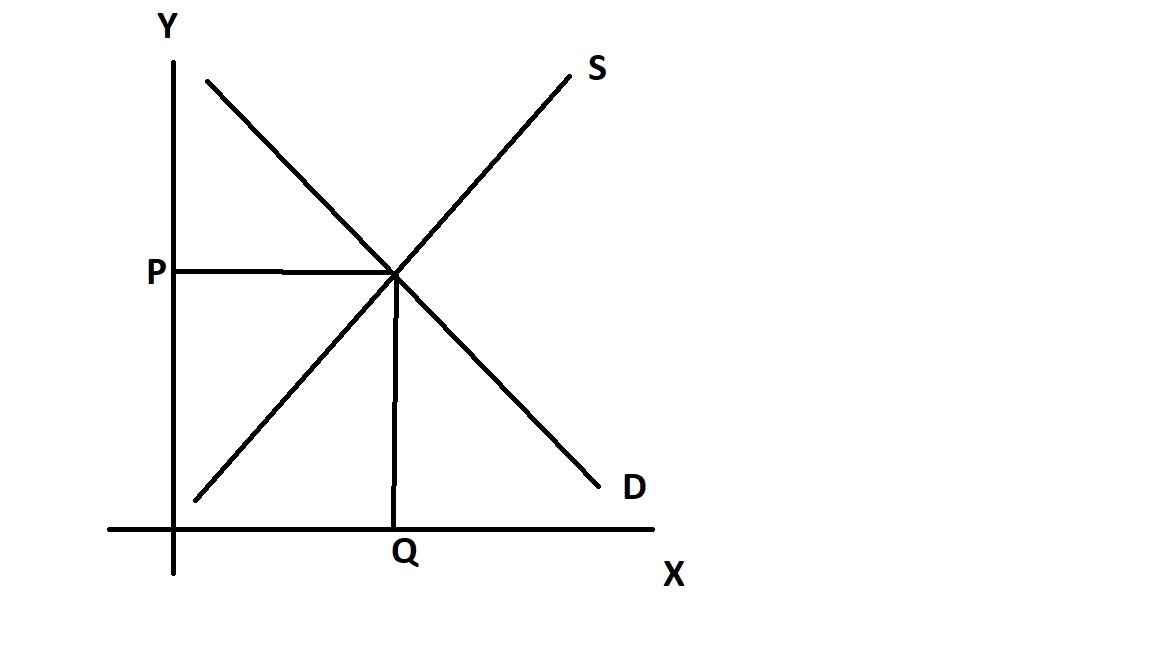
Firstly, the bills were introduced in the Rajya Sabha, after the same had been passed in the Lok Sabha. If a graph were to be plotted at this juncture of the situation, the Y-axis could be marked for the price incurred in enacting a legislation, while the X-axis could be marked for the number of legislations enacted. A straight (for simplicity) downward demand slope ‘D’ would represent the demand for this legislation, while an upward straight supply slope ‘S’ would represent the supply. Say the points where D and S intersect are represented as ‘P’ and ‘Q’ on the Y and X axes, respectively (Figure 1).
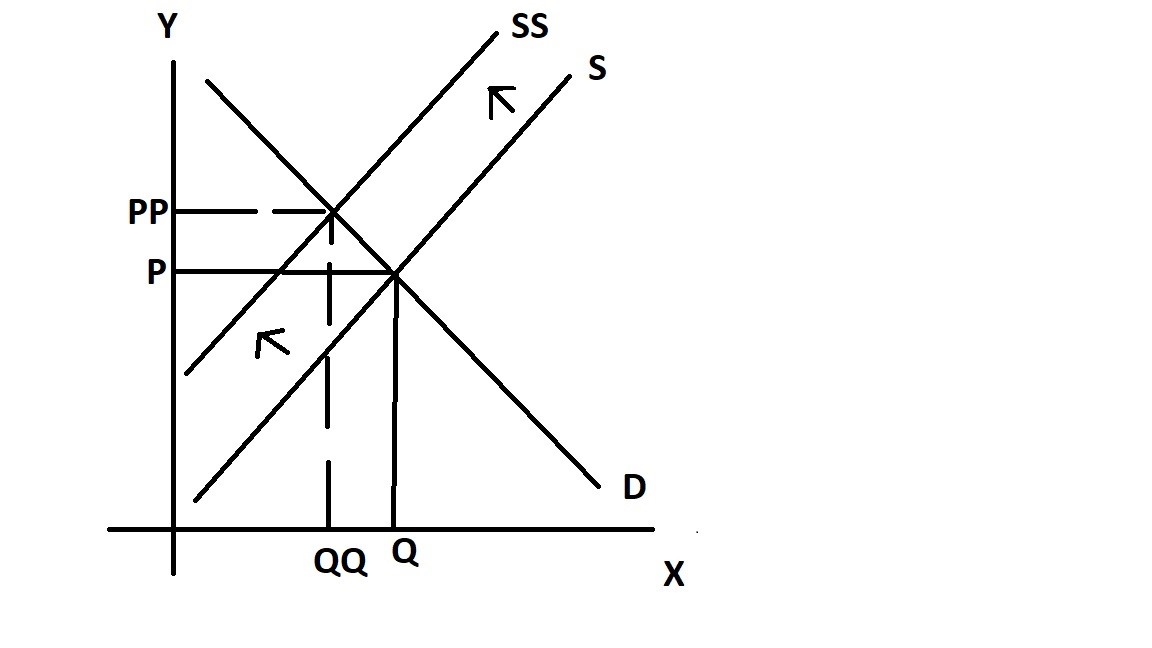
Now, if the bills were referred to a select committee of the Rajya Sabha, that would increase the amount of deliberation and research that went into the enactment of the same. This in turn, would increase the transaction costs in getting this legislation enacted (in terms of the time, and financial resources that would go into the same). On the graph, this would mean, that the supply of legislations enacted would decrease (an increase in the discussion and deliberation would make it harder for interest groups to get their way with law-making), the supply curve would shift leftwards (SS), increasing the price incurred in getting legislations enacted to PP (higher than P), and hence, decreasing the number of such legislations enacted to QQ (lesser than Q) (Figure 2).
Secondly, in what was a clear violation of the Rajya Sabha Rules of Procedure and Conduct of business in Rajya Sabha,[15] the repeated demand for a recorded vote was not conceded to, and the passage of voice-voting was adopted.[16] A bill requires the approval of a simple majority, that is, a majority of the members present and voting.[17] According to a newspaper report, 191 members were present on the day of the passing of these bills.[18] A majority of this number corresponds to a requirement of 96 votes. Neither the ruling party nor the opposition constituted this number by themselves. The ruling party fell five votes short of a majority, and would have had to rely on the third block parties for the same. These third block parties, such as Shiv Sena and AIADMK, inter alia, held 26 votes, and a recorded vote could have gone either way.[19] Therefore, the contest was close and based on just these 26 votes it could have gone either way. A recorded vote would have ascertained the exact number of votes and would have thus acted as an increased transaction cost in getting the legislation enacted. To circumvent this additional hindrance, the government chose the path of a relatively more arbitrary unrecorded vote, in which it was not possible to determine the numbers in favour and in opposition of the enactment of the bills. This ensured that the government would not have to face the transaction cost of proving their majority.
The Rajya Sabha, as a part of our constitutional structure, is reflective of the pluralism of the country, and of its perceptions, interests, and cultural perspective. The members of the Rajya Sabha are not directly elected representatives, and therefore, are not bound by the collective interests of a particular government. Thus, they add a greater transaction cost on a group seeking enactment of a legislation, and ensure that the public is not merely left at the mercy of the lower house as an agenda setter. Mocking the entire constitutional structure, and circumventing the perusal of Rajya Sabha, simply in order to hasten a particular legislation in favour of an interest group, as was done in this case, renders the entire essence of bicameralism, futile.
The manner in which these farm bills were passed, was certainly opposed to the entire idea of keeping a check on majoritarianism, and set a bad precedent for future governments to potentially exploit. This is where the judiciary should have stepped in, but by staying the enactment of farm bills on frivolous grounds, and not checking for the procedural imperfections, the judiciary also gave the impression that future governments need not worry about following procedural safeguards.
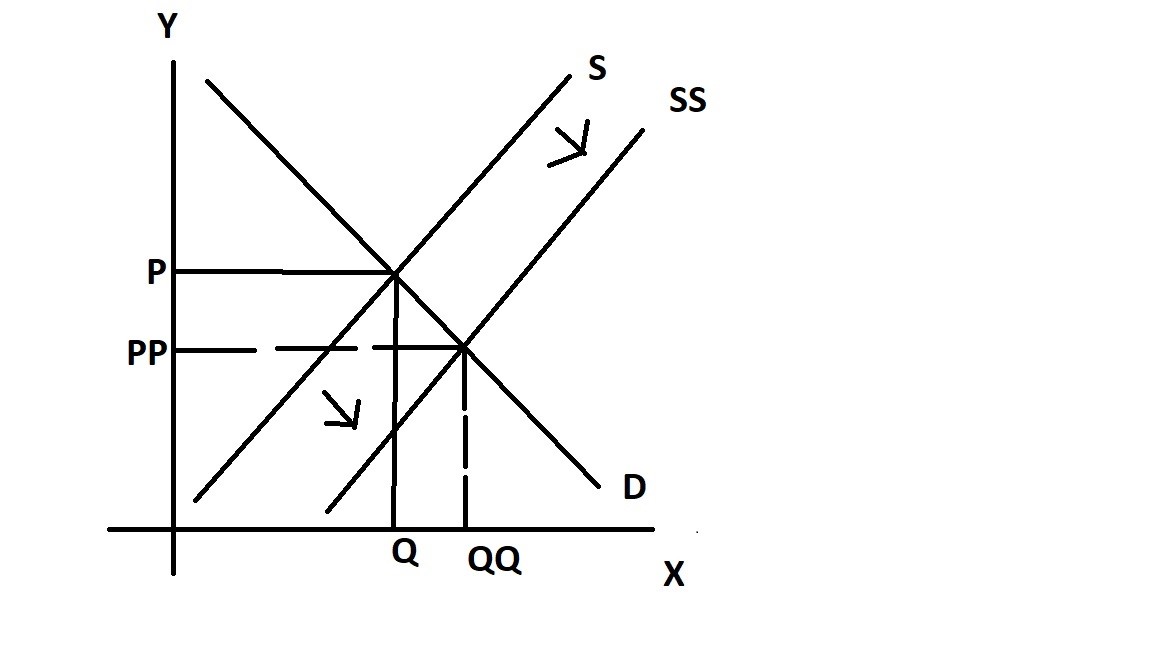
In terms of the representation of the same on a graph — the government increased the supply of legislations, shifting the supply curve ‘S’ rightwards (SS). With the demand being constant, this led to a decrease in the price of creating such legislations, and an increase in the quantity of legislations supplied, thus making it easier for them, to adopt and enact this legislation (Figure 3).
Fortunately, bicameralism is not the only source of transaction cost on legislations. The constitution has also installed a judiciary as an additional imposer of transaction costs. Once a bill has been passed, the onus lies on the judiciary to ensure that the procedural safeguards were adequately followed. This in turn, would ideally increase the transaction costs for getting a legislation enacted. However, in this case even this imposition of transaction cost failed.
Courts: Guardians of the constitution or public pacifiers?
The Honourable Supreme Court put an interim stay on the enactment of the farm bills.[20] From the lens of the transaction theory, this judgement was a failure. It failed as it could not act as an additional transaction cost on the passage of this legislation.
In a constitutional democracy such as ours, we do not need judgements that pacify public sentiment. The need is, instead, for judgements that pay equal heed to the substantive, as well as the procedural aspects of legislations. The procedural aspects are what determine the transaction costs incurred in getting the legislation enacted. The court had in this instance, an opportunity to evaluate the issues on the basis of their constitutionality and to look into whether the procedural standards had been complied with or not, but instead, in an extraordinary verdict, the court tried to “encourage the protestors to get back to their livelihoods”.[21] This is concerning for a myriad of reasons. Firstly, the court dealt with the protestors and their agony, and based the judgement on the same.[22] However they did not question the compliance with procedural safeguards. By doing so, the Supreme Court opened a floodgate for the potential governments to get away without even following a given set of procedures. Secondly, by basing the judgement purely on the need to encourage protestors to get back to their jobs,[23] it has sent a wrong message to the public. The decision has shown that a set of democratically unelected judges, have the authority, and now are in the practice of staying legislations passed by elected representatives, simply because a number of individuals refuse to budge.
From a transaction cost lens, this judgement has no impact in increasing the transaction cost for the legislature. The judiciary is required to ensure that procedural and substantive requirements of legislation-making are fulfilled. This would then warrant a strict compliance with the procedural rules on the part of the government. In this case, for one, the court did not declare these bills unconstitutional anywhere in the judgement, neither did it question the procedure followed. It simply hinged the decision on the need to “create a congenial atmosphere”.[24] This seems to give the idea that had these bills not led to an active widespread agitation on the part of the farmers, the court would not have found anything wrong with these bills!
Conclusion
As mentioned earlier, in order to ensure that interest groups do not engage in rent-seeking for their own benefit, it is imperative to have higher transaction costs on these activities. In this case, the imposition of transaction costs fell short in two ways:
- The imposition of transaction costs by the Rajya Sabha was circumvented by the enactment of the bills following a voice vote.
- The failure on the part of the judiciary to question the reasons behind the procedural steps taken in getting the legislation enacted.
If the government fails to respects the procedural safeguards put in place, it is the responsibiltity of the judiciary to build a model based on first checking for procedural compliances. The fact that these judges are not elected by the public, gives them the liberty to do so, and they ought to use the same to answer questions of constitutionality and procedure without worrying about the effects of a public outcry. From a transaction cost theory point of view, dealing with procedural aspects first, should be the practice in dealing with constitutional cases. This would ensure that:
- The governments will be more reluctant to circumevent the procedures laid down. Knowing that an entire legislation will be declared invalid if certain procedures are not complied with, will keep the governments more cautious about following procedural necessities.
- More parliamentary deliberations and referrals to parliamentary committees will follow from an ‘actively enquiring’ judiciary. Governments will be less willing to deviate from the established norms and procedures. This will result in sounder and more elaborate discussions, and hence better legislations.
The adoption of this transaction cost model, therefore, could go a long way in impeding any such attempt to hijack the legislative process.
The author, Dewesh Kumar Vinod, is a law student at the National Law School of India University (NLSIU), Bangalore.
[1] An interest group is a group of politically organized people that share a common goal and urge the government to provide for that goal. A lobby of shopkeepers, demanding for GST rebates would be an example of an interest group. See Jonathan R. Macey, Transaction Costs and the Normative Elements of the Public Choice Model: An Application to Constitutional Theory, 74 Virginia Law Review, 471, 472 (1988).
[2] In economic terms, transaction costs are the expenses incurred, in selling or buying a service or a good. They typically represent the labour needed to bring a service or a good to the market. For our purposes, transaction costs are any type of costs faced by interest groups in getting a legislation enacted. These costs can be imagined as hindrances or hurdles, which increase with every increasing procedural safeguard required to be followed, or with judicial interventions. See Jonathan R. Macey, Transaction Costs and the Normative Elements of the Public Choice Model: An Application to Constitutional Theory, 74 Virginia Law Review, 471, 472 (1988).
[3] Rent-seeking activity refers to the attempt of obtaining benefits (either political or economic) through governmental interventions. See Jonathan R. Macey, Transaction Costs and the Normative Elements of the Public Choice Model: An Application to Constitutional Theory, 74 Virginia Law Review, 471, 472 (1988).
[4] Jonathan R. Macey, Transaction Costs and the Normative Elements of the Public Choice Model: An Application to Constitutional Theory, 74 Virginia Law Review, 471, 472 (1988).
[5] Ibid, at 472.
[6] Ibid, at 512.
[7] The three farm bills taken together, propose reforms which tend to loosen rules around pricing, rules, and storage of farm produce. They also permit private entities to hoard essential commodities, which till now, was something that only the government could do. They have also outlined nation-wide common rules for contract-farming. The biggest change probably, is allowing farmers to sell their agricultural produce to private players directly. Up until now, the farmers used to sell their produce through governmet-controlled mandis. This is what has caused a lot of resentment amongst the farmers, who are contending that this will gradually lead to the end of mandis or wholesale markets and Minimum Support Prices (MSP) provided in those markets. Thus, in case they do not wish to sell their produce to private players, and want to fall back on the security of MSP and wholesale markets, they will be unable to do so. For more information, see https://www.bbc.com/news/world-asia-india-54233080.
[8] A voice vote entails the chairman/speaker posing a question to the house, and then gauging their opinions in the forms of ‘ayes (yes) or noes. On the basis of a rough apprehension of which side was louder, it is for the the chairman/speaker to decide if the motion fell through or passed. Therefore, there is no definite method of confirming the precise count of votes on either sides. See also https://scroll.in/article/973588/use-of-a-dubious-voice-vote-to-pass-critical-farm-bills-severely-dents-indian-democracy.
[9] A recorded vote or a “division” vote enatils the MPs and MLAs to record their vote electronically. This means that the number of votes for each side are precisely recorded. See also https://scroll.in/article/973588/use-of-a-dubious-voice-vote-to-pass-critical-farm-bills-severely-dents-indian-democracy.
[10] S. N. Sahu, The Way Farm Bills Passed in Rajya Sabha Shows Decline in Culture of Legislative Scrutiny, The Wire (21/9/2020), available at https://thewire.in/politics/farm-bills-rajya-sabha-legislative-scrutiny, last seen on 10/4/2021.
[11] S. 9.11.6, Manual of Parliamentary Procedures in the Government of India, (2018).
[12] Party Wise Representation of Members, available at https://loksabha.nic.in/members/PartyWiseStatisticalList.aspx (Last visited on June 14, 2021).
[13] The parliamentary procedural manuals provide for the formation of a number of parliamentary committees, voting procedures, and steps that need to be followed before and after a bill is passed. The entire procedural route that a bill needs to undertake, right from the initiation of a proposal of a legislation by the concernced ministry, to publishing and printing the passed bills, has been penned down and needs to be adhered to. For instance, any minister who is not a member of a select committee, can address that committee only with the permission of the Chairman (See s. 9.14.2 of the parliamentary procedure manual). In this manner, a procedural safeguard has been put in place, to increase the transaction cost on the government by ensuring that a minister is not able to coerce the committee members.
[14] Ch. 9, Manual of Parliamentary Procedures in the Government of India, (2018).
[15] S. 252, Rajya Sabha Rules of Procedure and Conduct of business in Rajya Sabha, (2013).
[16] A Jerath, Farm, Labour Bills Passed: Is This ‘End’ of Parliamentary Debate?, The Quint (25/09/2020), available at https://www.thequint.com/voices/opinion/modi-govt-bjp-farm-bills-labour-bills-passed-rajya-sabha-parliamentary-affairs-dissent-democracy, last seen on 11/04/2021.
[17] The Constitution of India, 1950, Art. 107(2).
[18] R Shrivastava, Numbers explain farm bill ruckus in Rajya Sabha, India Today (23/9/2020), available at https://www.indiatoday.in/india/story/nu mbers-explain-farm-bill-ruckus-in-rajya-sabha-1724425-2020-09-23, last seen on 11/04/2021. The India Today team accessed the attendance register for the day when the bill was passed, to be able to assess the support and opposition to the bills. This was done based on the number of members from each party present, and their stance with respect to the bills.
[19] Id.
[20] Rakesh Vaishnav v. Union of India, (2020) SCC OnLine SC 1032.
[21] Rakesh Vaishnav v. Union of India, (2020) SCC OnLine SC 1032, ¶15.
[22] The court, while looking at the petitions filed, and laying down the initial issues, said, “Though several rounds of negotiations have taken place between the Government of India and the farmers’ bodies, no solution seems to be in sight. The situation on ground is: (i) that senior citizens, women and children are at site, exposing themselves to serious health hazards posed by cold and covid; (ii) that a few deaths have taken place, though not out of any violence, but either out of illness or by way of suicide”. This “situation on ground” is what formed the basis of the judgement.
[23] The entire focus of the Supreme Court in this matter, was on the agitation and how the same can be called off as soon as possible. They did not question the compliance with procedural requirements even once, and took into account irrelevant considerations for staying the enactment of these bills. In para 8 of the judgement, the court said, “Be that as it may, the negotiations between the farmers’ bodies and the Government have not yielded any result so far. Therefore, we are of the view that the constitution of a Committee of experts in the field of agriculture to negotiate between the farmers’ bodies and the Government of India may create a congenial atmosphere and improve the trust and confidence of the farmers. We are also of the view that a stay of implementation of all the three farm laws for the present, may assuage the hurt feelings of the farmers and encourage them to come to the negotiating table with confidence and good faith”.
[24] Rakesh Vaishnav v. Union of India, (2020) SCC OnLine SC 1032, ¶8.

 The Journal of Indian Law and Society